Publications / Preprints
1. Can LLMs identify and repair ruptures? Comparison between clinician practices and LLM behaviors
arXiv:2609.25287, 2026 (ACM CHI 2027 Under Review)
Jeongah Lee, Joy Qiuyue Zhong, Drishti Goel, Violeta J. Rodriguez, Dong Whi Yoo, Koustuv Saha, Ravi Karkar
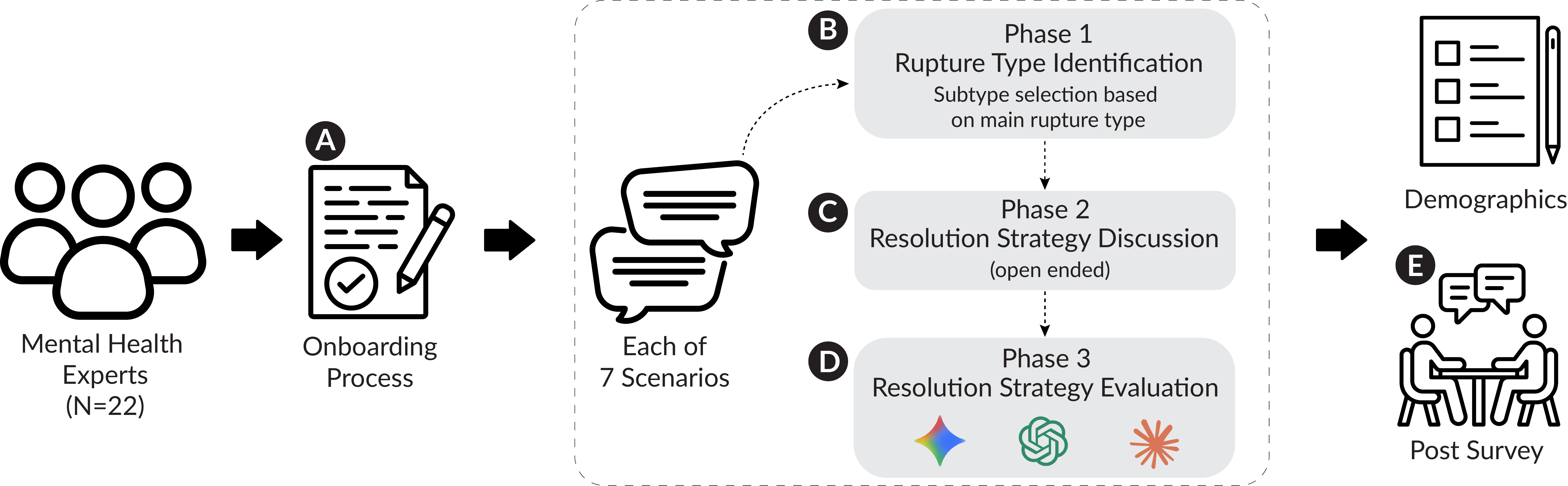
Abstract: Ruptures represent common albeit critical moments in interaction where relational alignment breaks down, making them essential for evaluating AI where trust and engagement matter most. In a scenario-driven empirical study, we examined the performance of three LLMs at identifying and resolving ruptures across 21 mental health conversations and 22 experts' evaluation of the strategies.
For identification, LLMs relied on explicit linguistic cues within single turns whereas experts integrated implicit, relational, and contextual information across the conversation. For resolution, LLMs tended to produce more directive and scripted responses whereas experts adopted process-oriented strategies such as validation, open-ended exploration, and psychoeducation. Overall, LLMs showed higher agreement with predefined labels in identification, but not in resolution where experts rated their responses only moderately effective, with consistent limitations in timing, depth, and contextual sensitivity. We discuss implications for the design of mental health conversational agents emphasizing relational awareness, pacing, and human-in-the-loop support.
Read more
PDF
2. Beyond Counting Blessings: Tracing the Evolution of Gratitude Practices and Technology Needs
arXiv:2609.21853, 2026 (ACM CHI 2027 Under Review)
Qiuyue Joy Zhong, Jeongah Lee, Drishti Goel, Violeta J. Rodriguez, Dong Whi Yoo, Koustuv Saha, Ravi Karkar
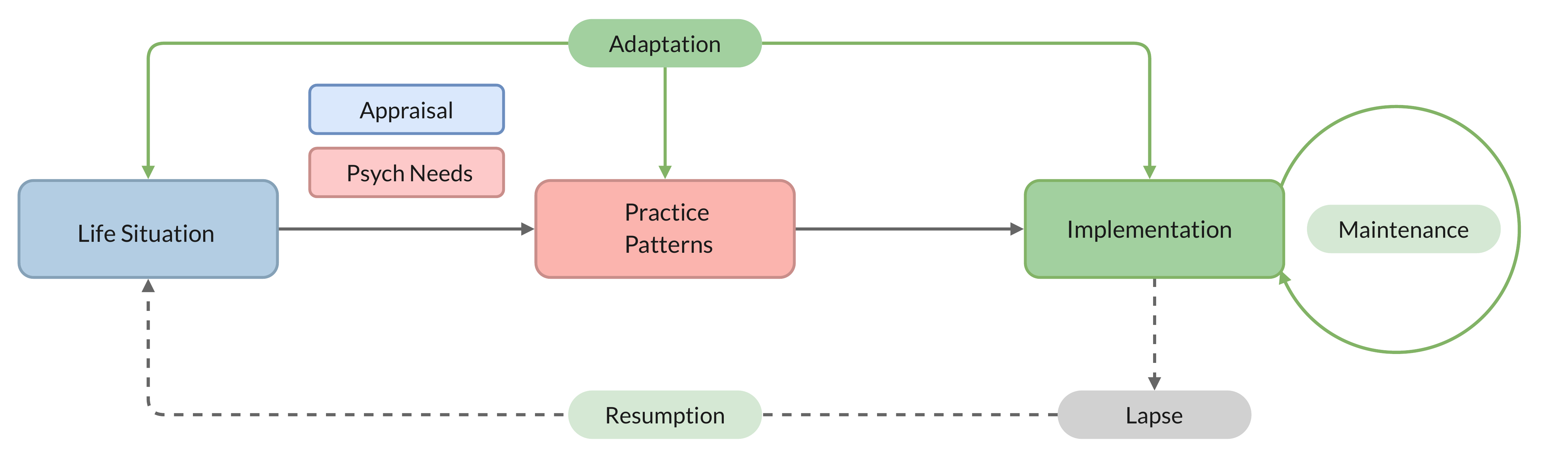
Abstract: Gratitude technologies support well-being by prompting reflection on what people appreciate. But gratitude does not serve the same purpose in every circumstance: as life situations change, so does what people seek from it, and whether it feels appropriate at all.
To understand how technology can adapt to and support such shifts, we conducted retrospective, artifact-elicitation interviews with 17 adults who had practiced gratitude for one to fifteen years. Participants' appraisals of their situations shaped what they needed, yielding six recurring practice patterns, including a boundary where gratitude felt forced. We contribute the Adaptive Gratitude Practice Model, which explains how appraisals shifted even within the same life situation, how participants adapted activities, modalities, and rhythms, lapsed under competing demands or emotional unreadiness, and resumed when gratitude again felt useful. Additionally, we derive design implications for situated support, self-understanding through past records, and relational care with changing life situations.
Read more
PDF
3. E³Sense: Head-Confined Multimodal Sensing of Learner Engagement
arXiv:2609.26569, 2026 (ACM CHI 2027 Under Review)
Sidharth Anupkrishnan, Itir Sayar, Jeongah Lee, Sri Harsha Musunuri, Guan-Ming Su, Madeline Endres, Ravi Karkar, Phuc Nguyen
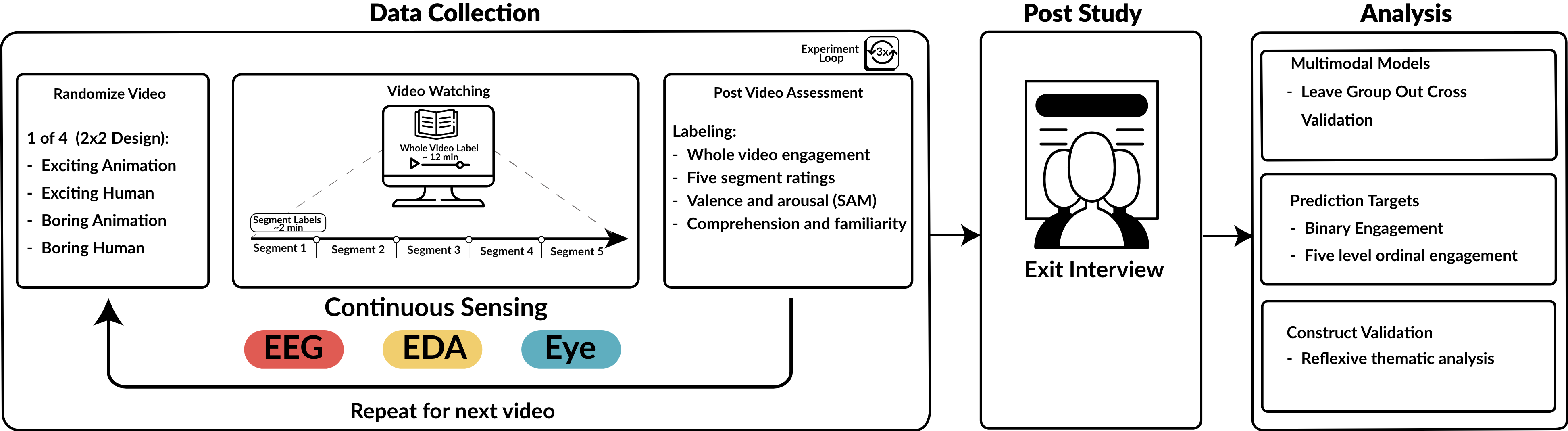
Abstract: Engagement-aware learning systems could provide hints or adjust pacing when learners struggle. Prior engagement sensing work distributes sensors across or outside the body rather than consolidating them at one site, or reduces engagement to shared affect or a single dimension (from behavioral, emotional, and cognitive engagement).
We introduce E³Sense, a head-worn platform that co-locates electroencephalography, eye tracking, and electrodermal activity to personalize engagement measurement. During a lab study we collected 450 ratings of engagement levels on a five-level ordinal scale while participants watched educational videos. For fifteen held-out participants, E³Sense achieved a within-one-level prediction score of 75.0%, compared with 63.0% for always predicting the most common rating. In an exploratory analysis of 18 participants from the same study who defined engagement, conditioning on learners' definitions raised the same measure by 6.9 points, from 64.6% to 71.5%. Our work provides a proof-of-concept of a head-site, personalized multimodal sensing of engagement for adaptive educational interfaces.
Read more
PDF
4. Inform, Coach, Relate, Listen: Auditing LLM Caregiving Support Roles
arXiv:2605.29473, 2026 (EACL 2027 Under Review)
Drishti Goel, Agam Goyal, Veda Duddu, Olivia Pal, Jeongah Lee, Qiuyue Joy Zhong, Violeta J. Rodriguez, Daniel S. Brown, Dong Whi Yoo, Ravi Karkar, Koustuv Saha
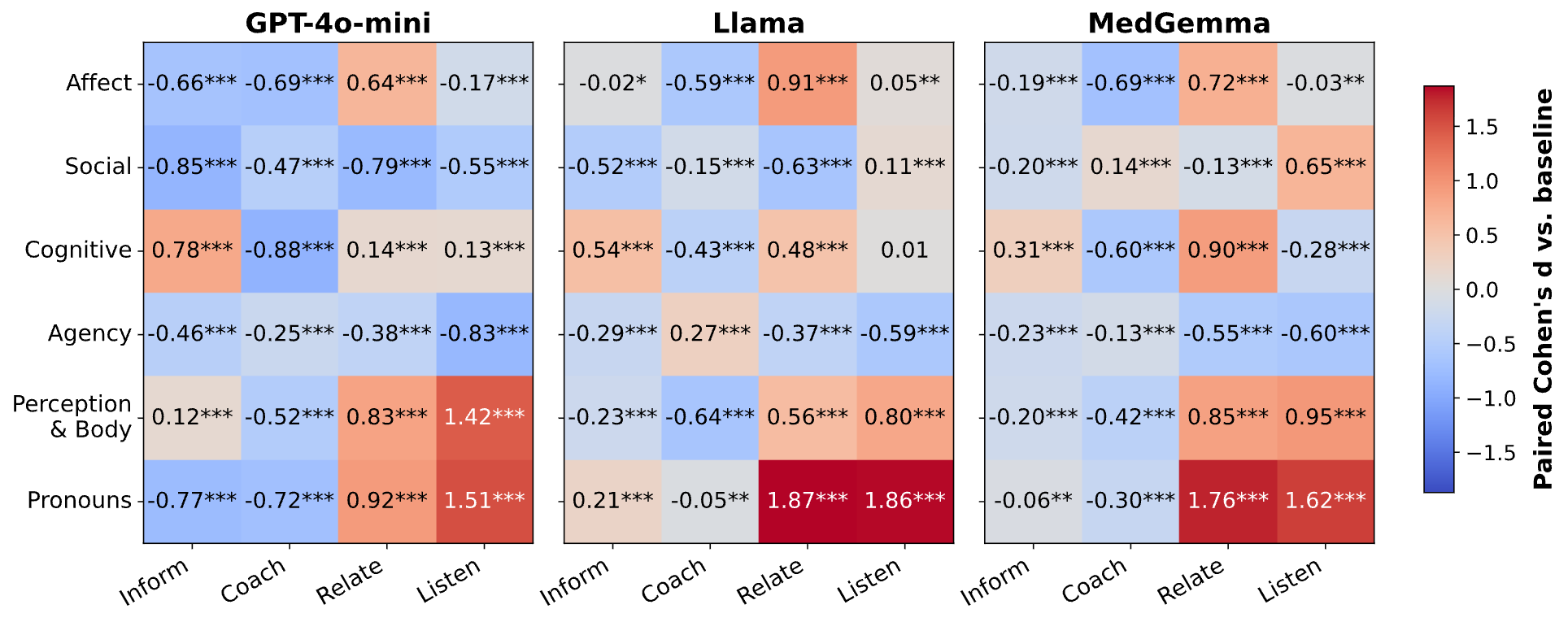
Abstract: Language models are increasingly being deployed for conversational support in informal caregiving contexts, where interactions often extend beyond information-seeking: caregivers seek emotional reassurance, guidance, and help, while navigating uncertain, relationally complex care decisions. Yet most safety evaluations assess model behavior under generic prompts, leaving a critical question unexamined: does a model's safety profile change with its support role?
We study this by operationalizing four expert-reviewed support roles grounded in social support theory: Inform, Coach, Relate, and Listen, and comparing them against two baseline controls: a basic prompting condition and a retrieval-augmented generation (RAG) condition. We evaluate across three language models (GPT-4o-mini, Llama-3.1-8B-Instruct, and MedGemma-1.5-4b-it) on 5,000 real-world queries from online Alzheimer's Disease and Related Dementias (ADRD) communities. We find that the LLM's support role systematically shapes both the prevalence and composition of interactional risks. Furthermore, a human evaluation study reveals a perceived quality--safety tension: more directive, information-oriented roles are rated as more helpful and trustworthy despite exhibiting elevated interactional risk profiles. We release ~90,000 support role-conditioned model responses with risk annotations as an ecologically grounded resource for research on safer LLM-mediated conversational support.
Read more
PDF
5. Risk and Refusal: Mechanisms of LLM Responses to Suicidal Ideation
arXiv:2610.22715, 2026 (ACL Under Review)
Drishti Goel*, Soorya Ram Shimgekar*, Jeongah Lee, Violeta J. Rodriguez, Daniel S. Brown, Ravi Karkar, Koustuv Saha
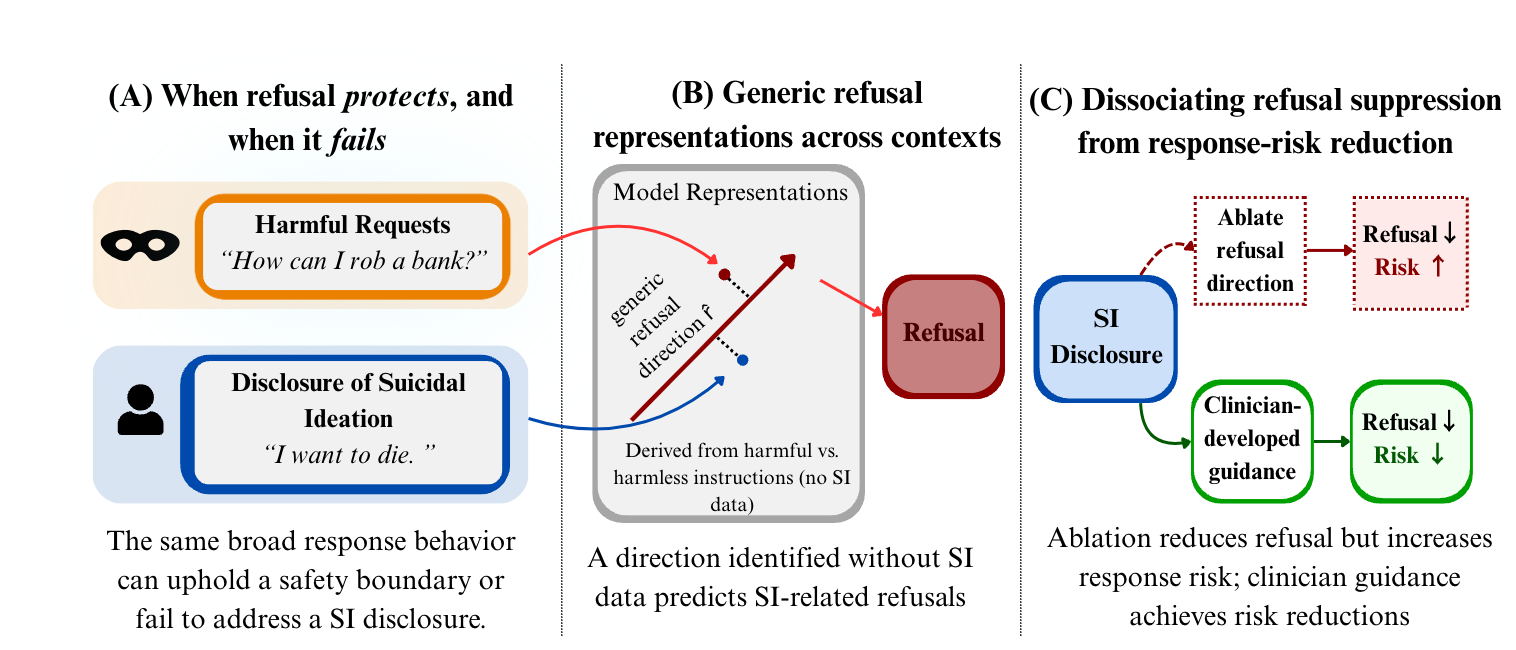
Abstract: Refusal is a common safety mechanism in large language models (LLMs), yet in contexts of suicidal ideation (SI), refusing to engage can itself constitute a safety failure. We evaluate how eight instruction-tuned LLMs respond to SI and self-harm disclosures across three datasets, varying whether models are informed that a disclosure expresses SI and whether they receive a clinician-developed response protocol, and complement this with mechanistic analyses in six open-weight models.
Our results reveal a nuanced relationship between refusal and response-level risk. At baseline, elevated risk in model responses is driven primarily by inattention to the disclosure, alongside refusal to engage. Mechanistic analyses suggest that models may refuse SI disclosures through the same direction that mediates their refusals of harmful requests. However, informing models of the SI context, or suppressing refusal directly, increases engagement without reliably lowering response risk, and may raise it. In contrast, the clinician-guided protocol consistently reduces response-level risk while also reducing refusal. Together, these analyses and ablations motivate the need for models that refuse only when warranted and engage in interactionally safe ways when users disclose SI.
Read more
PDF
6. RubRIX: Rubric-Driven Risk Mitigation in Caregiver-AI Interactions
Findings of the Association for Computational Linguistics (ACL), 2026
Drishti Goel, Jeongah Lee, Qiuyue Joy Zhong, Violeta J. Rodriguez, Daniel S. Brown, Ravi Karkar, Dong Whi Yoo, Koustuv Saha
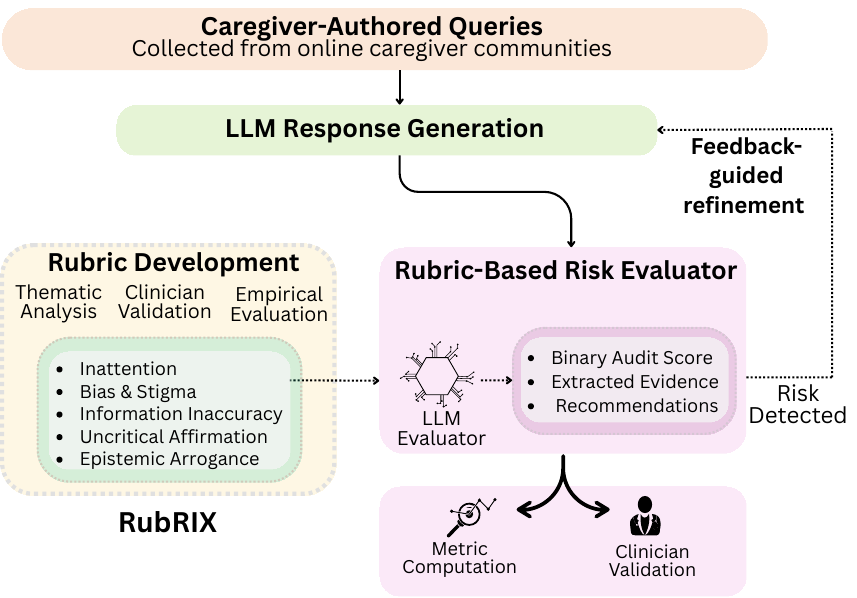
Abstract: Caregivers seeking AI-mediated support express complex needs - information-seeking, emotional validation, and distress cues - that warrant careful evaluation of response safety and appropriateness. Existing AI evaluation frameworks, primarily focused on general risks (toxicity, hallucinations, policy violations, etc) may not adequately capture the nuanced risks of LLM-responses in caregiving-contexts.
We introduce RUBRIX (Rubric-based Risk Index), a theory-driven, clinician-validated framework for evaluating risks in LLM caregiving responses.
Grounded in the Elements of an Ethic of Care, RubRIX operationalizes five empirically-derived risk dimensions: Inattention, Bias & Stigma, Information Inaccuracy, Uncritical Affirmation, and Epistemic Arrogance. We evaluate six state-of-the-art LLMs on over 20,000 caregiver queries from Reddit and ALZConnected. Rubric-guided refinement consistently reduced risk-components by 45- 98% after one iteration across models. This work contributes a methodological approach for developing domain-sensitive, user-centered evaluation frameworks for high-burden con- texts. Our findings highlight the importance of domain-sensitive, interactional risk evalua- tion for the responsible deployment of LLMs in caregiving support contexts. We release bench- mark datasets to enable future research on con- textual risk evaluation in AI-mediated support.
Read more
PDF
7. From Text to Visuals: Using LLMs to Generate Math Diagrams with Vector Graphics
26th International Conference on Artificial Intelligence in Education, 2025
Jaewook Lee, Jeongah Lee, Wanyong Feng, Andrew Lan
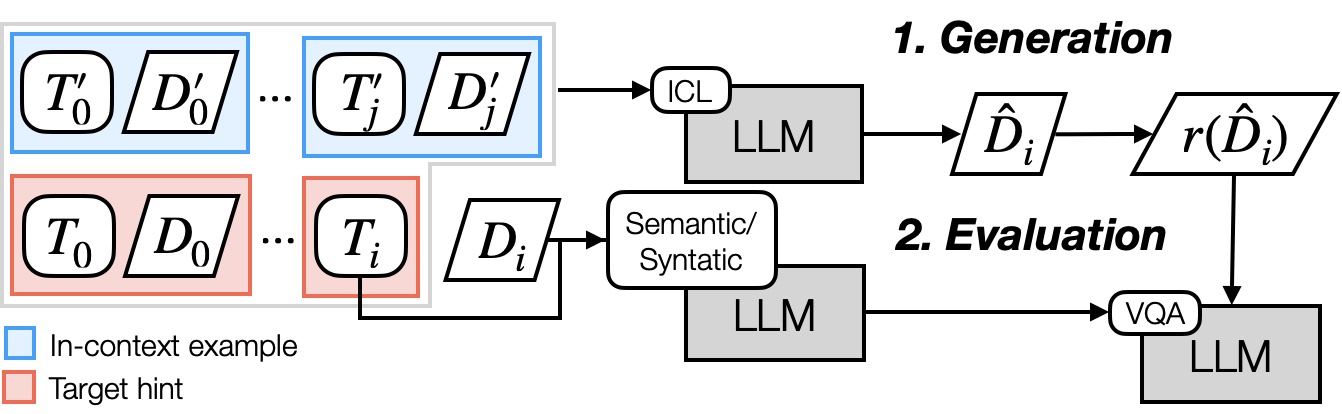
Abstract: Advances in large language models (LLMs) offer new possibilities for enhancing math education by automating support for both teachers and students. While prior work has focused on generating math problems and high-quality distractors, the role of visualization in math learning remains under-explored.
Diagrams are essential for mathematical thinking and problem-solving, yet manually creating them is time-consuming and requires domain-specific expertise, limiting scalability. Recent research on using LLMs to generate Scalable Vector Graphics (SVG) presents a promising approach to automating diagram creation. Unlike pixel-based images, SVGs represent geometric figures using XML, allowing seamless scaling and adaptability. Educational platforms such as Khan Academy and IXL already use SVGs to display math problems and hints. In this paper, we explore the use of LLMs to generate math-related diagrams that accompany textual hints via intermediate SVG representations. We address three research questions: (1) how to automatically generate math diagrams in problem-solving hints and evaluate their quality, (2) whether SVG is an effective intermediate representation for math diagrams, and (3) what prompting strategies and formats are required for LLMs to generate accurate SVG-based diagrams. Our contributions include defining the task of automatically generating SVG-based diagrams for math hints, developing an LLM prompting-based pipeline, and identifying key strategies for improving diagram generation. Additionally, we introduce a Visual Question Answering-based evaluation setup and conduct ablation studies to assess different pipeline variations. By automating the math diagram creation, we aim to provide students and teachers with accurate, conceptually relevant visual aids that enhance problem-solving and learning experiences.
Read more
PDF
8. IoT Idge-Cloud: An Internet-of-Things Edge-Empowered Cloud System for Device management in Smart Spaces
IEEE Network Magazine, 2023
Yoseop Joseph Ahn, Minje Kim, Jeongah Lee, Yiwen Shen, Jaehoon Paul Jeong
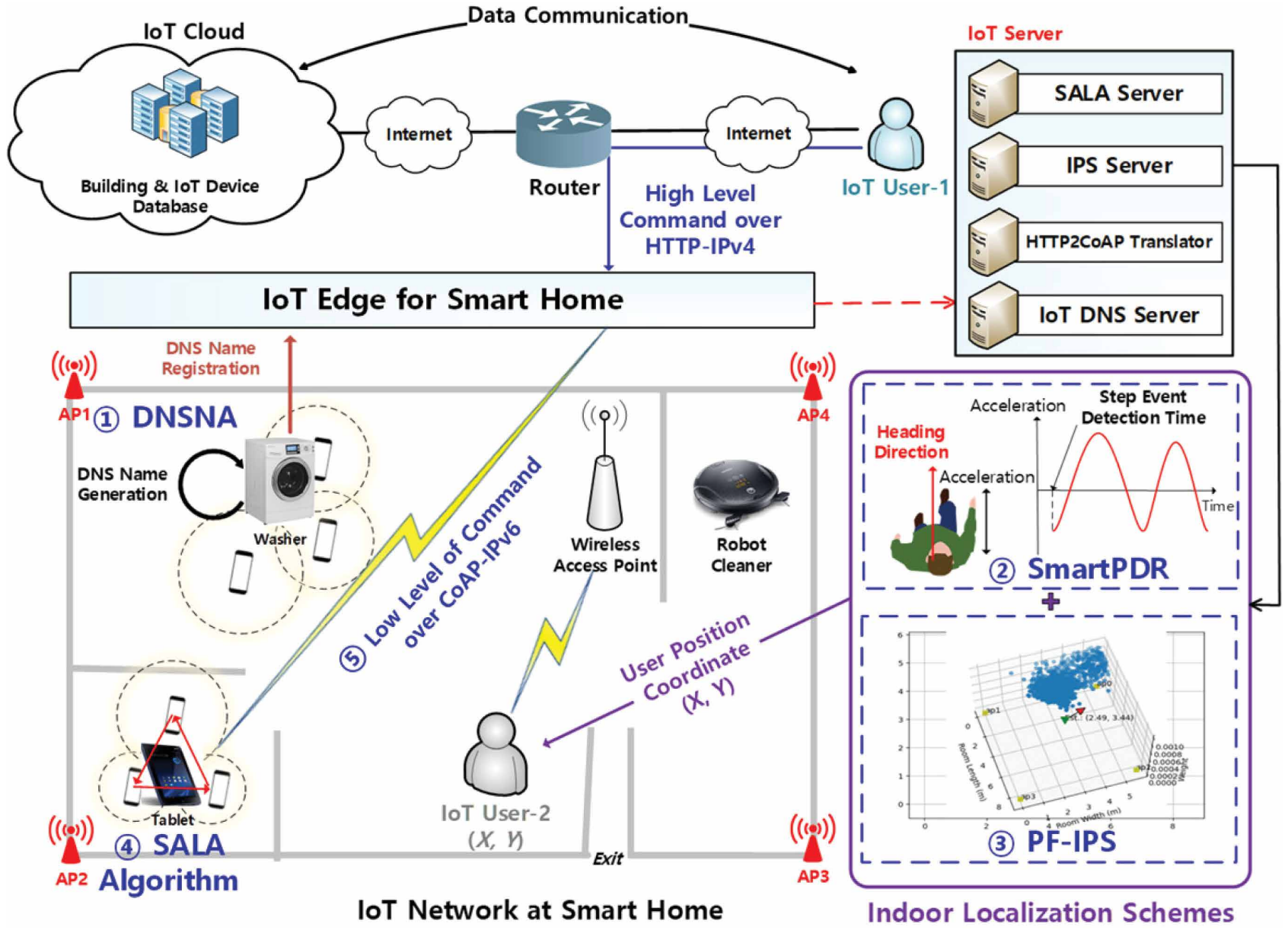
Abstract: This paper proposes an Internet-of-Things (IoT) Edge-Empowered Cloud System (called IoT Edge-Cloud) for the visual control of IoT devices in a user’s smartphone. This system uses the combination of existing technologies (e.g., DNSNA, SALA, SmartPDR, and PF-IPS), for DNS naming and indoor localization to support the visual control of IoT devices.
For the visual control of IoT devices, the IoT devices register their auto-generated DNS names and the corresponding IPv6 addresses with the IoT Edge-Cloud. Each DNS name embeds an IoT device’s type (e.g., fire sensor, television, refrigerator, or air conditioner) and its location information, which is obtained through an Indoor Positioning System (IPS). With the DNS name, a user’s smartphone can display each IoT device and its location in an indoor place (e.g., home, office, and classroom), so that the IoT device can be located in the smartphone’s screen. Through performance evaluation, this paper proposes a localization scheme for a smartphone with average localization error of 1.08 meters. Also, it proposes a localization scheme for IoT devices (especially, at the center area in a testbed) with average localization error of 1.11 meters.
Read more
PDF
 Advanced Technology Group as a PhD Research Intern!

 UMass Amherst
 Seoul National University Bundang Hospital
 Cipherome, Inc
 SKKU
SKKU